
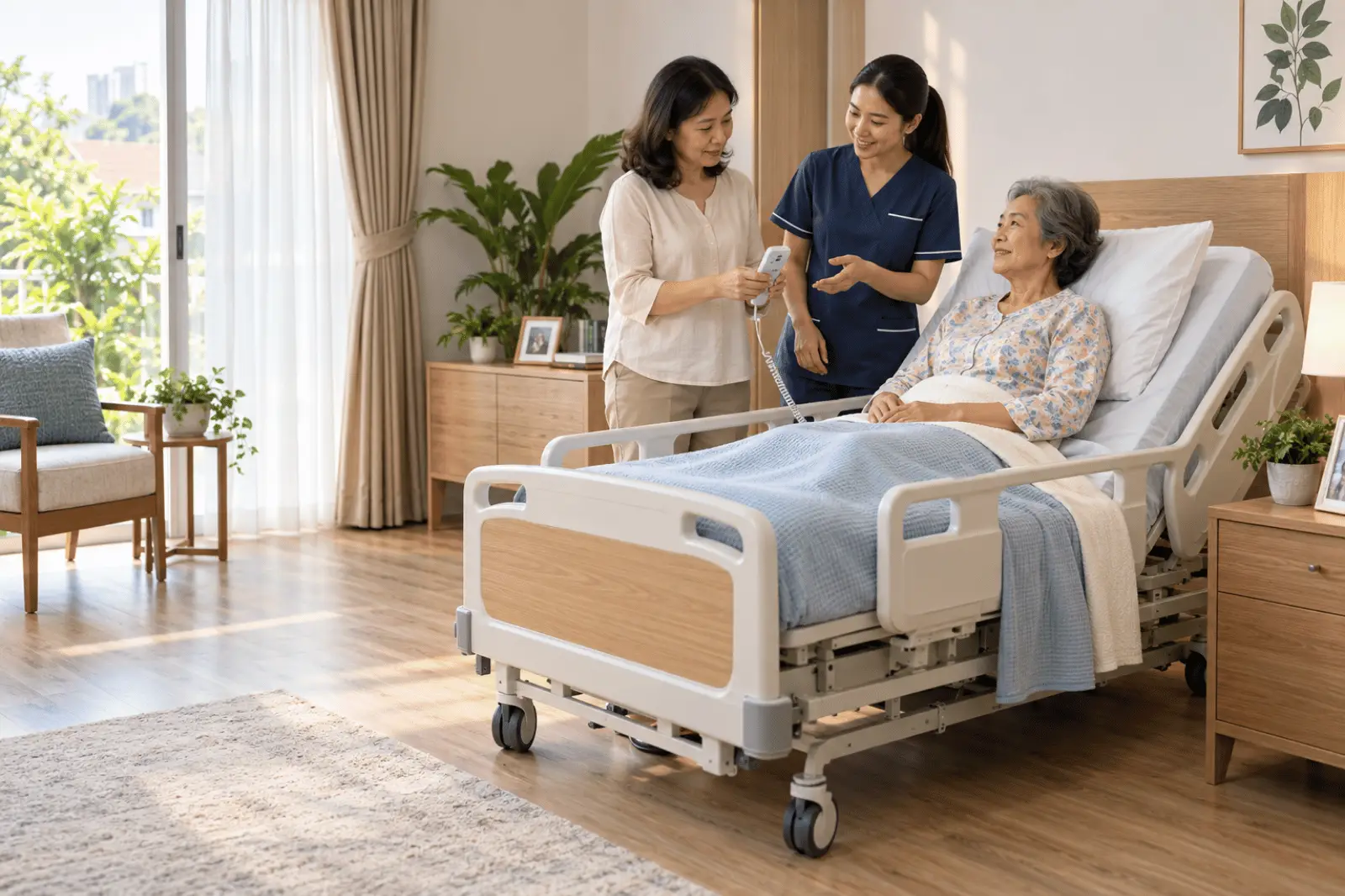
Hospital discharge can happen faster than families expect. Suddenly, a parent or loved one is coming home, and the existing bedroom has to support medication, meals, changing, repositioning and transfers. Many families plan the equipment after the patient arrives—then discover on the first night that an ordinary bed is too low, too soft or too difficult to work around.
A hospital bed for home is not about turning the bedroom into a ward. It is about creating a safer working height, more useful positioning and a routine that one caregiver can manage more comfortably. Choosing before discharge gives the family time to measure, compare and prepare rather than buying under pressure.
What Buyers and Caregivers Are Actually Worried About
Most families do not begin with a product specification. They begin with a moment that feels increasingly difficult:
- The patient cannot sit upright or reposition without considerable assistance.
- The caregiver must bend deeply during changing, cleaning or wound care.
- Transfers between the bed and wheelchair feel unstable.
- The family does not know whether a manual or electric hospital bed is worth buying.
- Delivery day is approaching, but the room has not been measured or rearranged.
What Happens When Families Keep Waiting
Waiting until after discharge can lead to rushed purchases, difficult first nights and unnecessary strain. The patient may be uncomfortable, while the caregiver improvises with pillows, low mattresses or unsuitable furniture. A poorly prepared room can also make every transfer slower and more stressful.
What the Right Purchase Can Change
The right hospital bed supports the positions the patient actually needs and reduces repeated manual effort for the caregiver. Combined with a suitable mattress and enough space around the bed, it creates a more workable homecare environment from the first day.
The Detail Most Buyers Overlook
One person may want to raise the backrest independently before eating, reading or settling down for the night. Another may rely on a caregiver for every adjustment. Some households change positions several times a day, while others rarely move the bed once a comfortable setup has been found.
This is the detail that changes the answer. If the user needs direct control or the care routine involves frequent changes, powered adjustment may make a meaningful difference. If adjustments are occasional and a capable helper is always available, a manual bed may provide everything the routine needs without unnecessary complexity.
Electric Powered Hospital Beds for Frequent Adjustments
An electric hospital bed uses a handset or control panel to move selected sections. Across electric powered hospital beds, these movements may include the backrest, leg section and overall bed height. The main advantage is not simply the number of motors. It is the ability to make repeated changes without operating a hand crank each time.
This can suit users who are able to manage the controls independently, as well as caregivers who need to alter the working height during daily care. Before choosing, check which movements are powered, whether the controls can be locked and what the emergency lowering process is.
The room must also support the electrical setup. Consider the location of the power point, cable routing and what happens during a power interruption. If a bed includes a backup system or emergency manual crank, confirm exactly which functions it can operate.
Manual Hospital Beds for Simpler Routines
Manual hospital beds use hand cranks to adjust the available sections. They can be a practical choice when changes are infrequent, a caregiver can operate the bed comfortably and powered height adjustment is not needed throughout the day.
Manual does not automatically mean easier. The caregiver must be able to reach and turn each crank without awkward movement, and the foot end needs enough clearance. Check whether the cranks fold away, how smoothly they operate and whether the bed has fixed or adjustable height.
The better manual option is not necessarily the model with the most functions. It is the one that keeps a straightforward routine organised without shifting unnecessary physical effort onto the caregiver.
Let the Home Setup Shape the Choice
A hospital bed for home must fit more than the person using it. Measure the entrance, corridor turns, lift if relevant, room width and the working space around the bed. A model that technically fits the room may still leave too little clearance for transfers, cleaning or access from both sides.
Bed height also affects the routine. The lower position may influence how the user gets in and out, while the upper position may affect how comfortably a caregiver can assist. For a medical bed for home use, these practical measurements can matter more than an extra feature on the product page.
Function Count Does Not Tell the Whole Story
Labels such as 2 function hospital bed, 3 function hospital bed or multi-function model are useful shortcuts, but the exact movements can vary. Read the specification rather than assuming what each number means. Check the backrest and leg-rest ranges, hi-lo adjustment, side tilting and how every control is operated.
Confirm the safe working load, overall hospital bed size and mattress dimensions as one package. The mattress should be compatible with the frame and move correctly with the platform. Any specialised pressure-care requirement should be discussed with a qualified healthcare professional.
Judge the bed as a complete setup. Confirm what is included, along with delivery, installation, training, warranty, servicing and the caregiver effort involved, instead of comparing the adjustment type alone.
Side Rails Need Individual Judgement
The bed frame, mattress, side rails and accessories work as one system. An incompatible mattress or rail can create gaps, while side rails can introduce entrapment or climbing risks for some users. Use components approved for the specific bed and follow the manufacturer’s instructions.
An individual assessment is especially important when the user is frail, confused, restless or has limited mobility. The setup should also be reviewed when mobility, weight, the mattress, accessories or the home environment changes.
Neolee Hospital Beds to Compare
These Neolee options cover different home-care routines, from straightforward manual adjustment to powered hi-lo control and broader multi-function positioning.
Hospital Bed 2 Function (Manual) — A straightforward manual model for families who need backrest and leg-rest adjustment without powered controls.
Hospital Bed 3 Function (Manual Hi-lo) — A manual option that adds height adjustment for routines that need more flexibility.
Hospital Bed 3 Functions (Electric Hi-lo) — A powered alternative for users or caregivers who expect to adjust the bed more frequently.
Hospital Bed 5 Functions (Manual) — A multi-function manual model with additional positioning and personal-care features for a more involved routine.
Hospital Bed 6 Functions (Electric Hi-lo) — A powered multi-function design for families comparing hi-lo adjustment, side tilting and additional care features.
Browse the full Neolee hospital beds collection, then compare electric powered hospital beds and manual hospital beds by the way care actually happens at home.
Take the Next Step Before the Routine Gets Harder
Prepare the room before discharge day—not after the first difficult night. Compare NeoLee manual and electric hospital beds, then confirm dimensions, functions, mattress compatibility and delivery access with the team.
Practical Checklist Before You Buy
Bring the following information when comparing models online or speaking with a supplier:
- Who will operate the bed and how often
- Need for backrest, knee, hi-lo or other adjustments
- User’s transfer method and caregiver working height
- Room, doorway, lift and delivery-route dimensions
- Bed capacity, mattress compatibility and side-rail plan
- Power socket location and contingency for outages
- Cleaning, servicing and warranty arrangements
Where a user has a wound, sudden mobility change, significant pain, complex posture or a prescribed clinical plan, confirm the decision with the relevant healthcare professional.
Useful NeoLee Internal Links
Continue your research through the most relevant product categories:
Frequently Asked Questions
1. What is the difference between electric and manual hospital beds?
Electric beds use powered controls for selected adjustments, while manual beds use hand cranks. The available functions vary by model.
2. Is an electric hospital bed better for home care?
It may be more practical when positioning changes are frequent or the user needs accessible controls. A manual bed may suit simpler routines and budgets.
3. How many functions does a hospital bed need?
Choose functions that solve real care tasks. More functions are not automatically necessary if they will rarely be used.
4. What does hi-lo mean?
Hi-lo refers to raising or lowering the overall bed platform, which may help transfers and caregiver working height.
5. Can any mattress be used on a hospital bed?
No. Mattress dimensions, flexibility, support needs and compatibility with the bed platform should be confirmed.
6. Are side rails always safer?
Not in every situation. Rails require individual assessment because they can affect transfers, entrapment risk and access.
7. What room measurements are important?
Measure the bed footprint, doorways, lift, turning space and working clearance on the sides and foot end.
8. What happens during a power failure?
This depends on the model. Ask about emergency lowering, battery backup or manual procedures before purchase.
9. Can a hospital bed be delivered upstairs?
Delivery feasibility depends on stairs, lifts, access and assembly requirements. Confirm the route with the supplier in advance.
10. Where can I compare hospital beds in Malaysia?
NeoLee’s hospital beds category includes manual and electric powered hospital beds for home-care comparison.