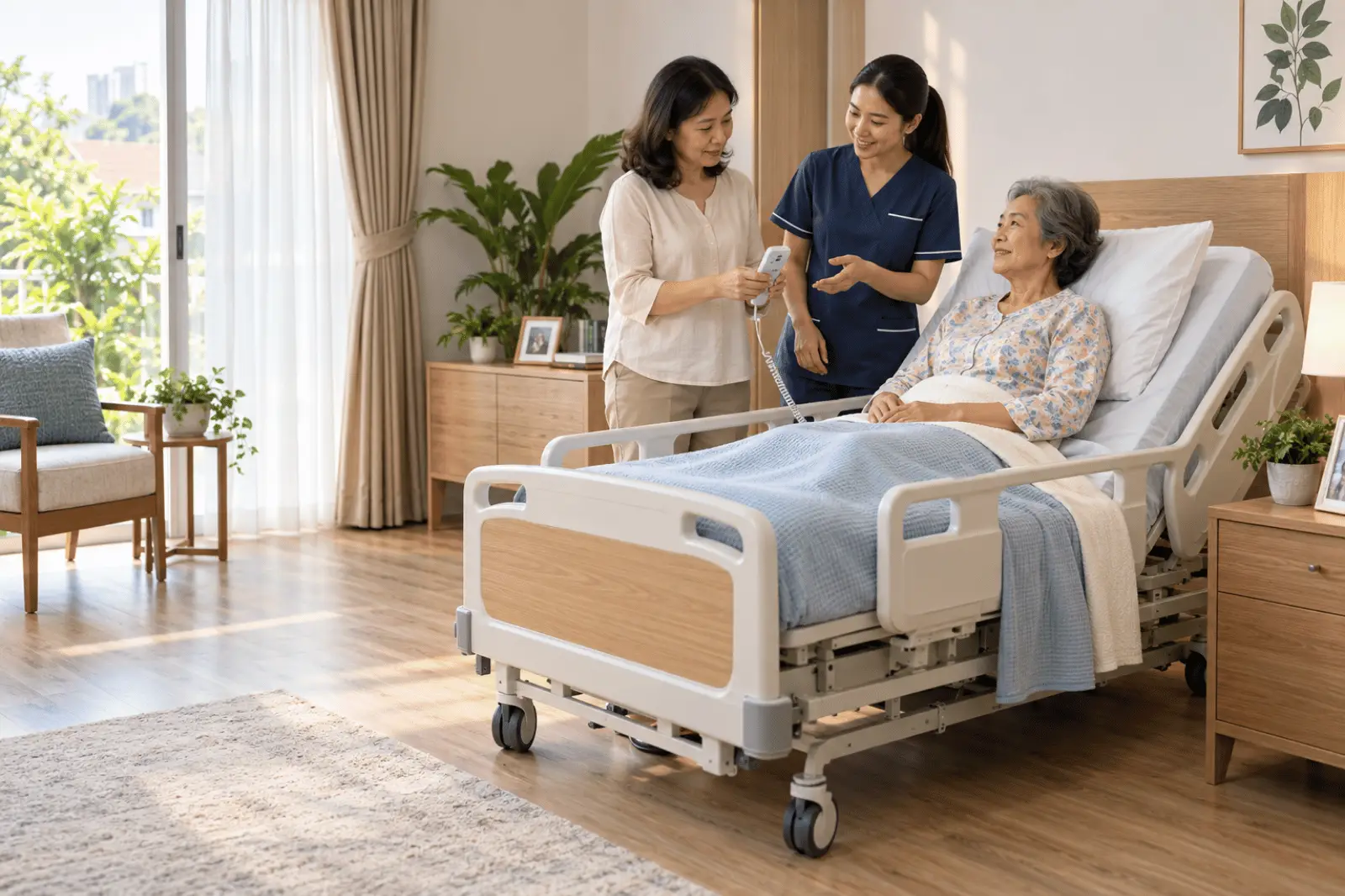
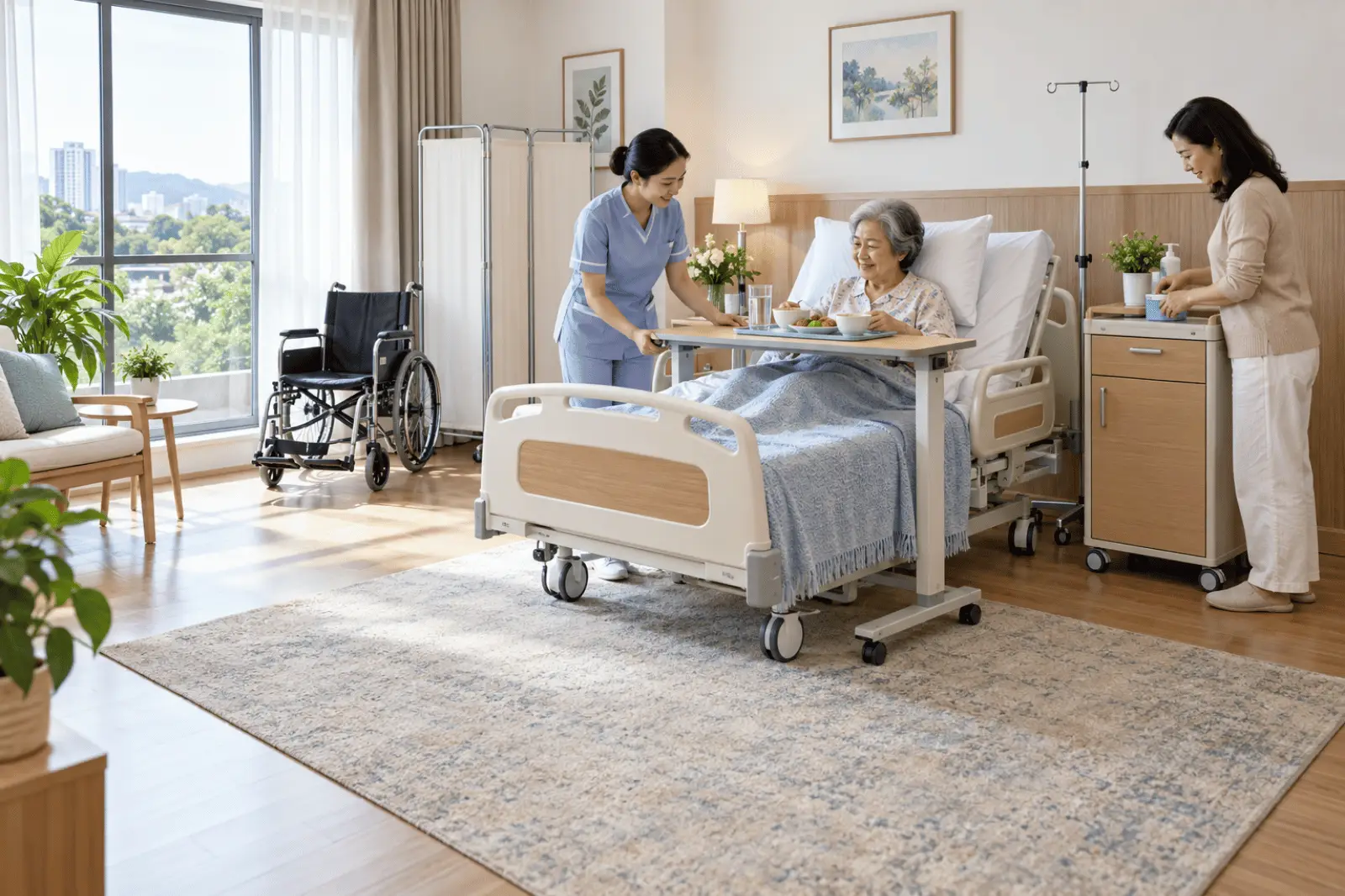
A hospital bed may be the biggest item in a recovery room, but it is rarely the only one that affects daily care. Meals, medication, tissues, personal items, mobility aids and medical supplies all need a place. Without the right setup, the room quickly becomes crowded, and the caregiver spends the day moving objects from one unsuitable surface to another.
Practical hospital furniture can make the room feel more organised and less clinical at the same time. An overbed table, bedside cabinet, privacy screen or mobile stand earns its value by keeping essential tasks within reach and reducing unnecessary movement.
What Buyers and Caregivers Are Actually Worried About
Most families do not begin with a product specification. They begin with a moment that feels increasingly difficult:
- Meals and medication are balanced on unstable stools or bedside surfaces.
- Frequently used supplies are stored too far from the caregiver.
- Furniture blocks wheelchair transfers or access to the bed.
- The room has no privacy solution for personal care.
- The family buys pieces separately without checking height, castors or compatibility.
What Happens When Families Keep Waiting
A disorganised recovery room creates small frustrations that repeat all day: spills, misplaced items, blocked pathways and unnecessary bending. Over time, these details can exhaust the caregiver and reduce the patient’s independence. Waiting until the room becomes chaotic often leads to buying whatever is immediately available rather than what fits.
What the Right Purchase Can Change
The right hospital furniture keeps meals, personal items and care supplies where they are needed. It can free transfer space, support privacy and make cleaning easier. The room becomes a system designed around the patient and caregiver rather than a collection of unrelated products.
Begin With Activities, Not Room Names
List what happens around each bed or treatment position: observations, medication, meals, personal care, transfers, family visits and cleaning. Then mark where staff, equipment and mobile furniture must stand during each activity.
This exposes competing needs early. A hospital bedside cabinet may be reachable by the patient but block equipment access. A ward screen may provide privacy but reduce the clear route to the door if its folded position was never planned.
Check Interfaces Between Products
Measure bed height range, under-bed clearance, mattress width, chair arms, wall services and floor space. A hospital overbed table must interface with these items through its base, column and tabletop – not merely fit within the room.
Where several bed or chair models are used, test the furniture against each one. Standardising without checking interfaces can create a product that works well in one ward and poorly in another.
Adjustability Must Be Reachable
An adjustable overbed table is helpful only if the intended user can operate it and staff can position it without awkward force. Check control location, movement range, stability and whether the surface remains practical at common working heights.
The search term cardiac table is often used for an overbed-style support surface. Whatever the label, confirm the actual design and intended use. Do not assume every mobile table supports the same loads, positions or clinical activities.
Cleaning Is a Design Requirement
Review seams, handles, corners, castors and joints where contamination may collect. Confirm compatibility with the facility’s cleaning agents and processes. Materials that look smooth from a distance may have complex edges that slow turnaround.
Ask the environmental-services team to participate in evaluation. Their feedback can reveal access problems, water traps or manoeuvring difficulties that a procurement checklist may miss.
Mobility Requires a Parking Plan
Castors help furniture move, but every mobile item also needs a predictable place when it is not in use. Check brakes, steering, thresholds, lift access and the risk of blocking emergency routes.
For a privacy wardscreen, test both deployed and stored footprints. For an infusion stand, consider stability, hook arrangement and movement with other equipment. Follow facility policy for device and load compatibility.
Pilot One Room Before Standardising
A full-scale mock-up or short pilot can reveal collisions that drawings miss. Ask staff to complete common tasks while observers note reach, bending, repositioning and cleaning access. Include both day and night workflows when staffing and equipment placement differ.
Document the final room arrangement, including the parked location of mobile items. This turns a successful trial into a repeatable standard and gives future teams a clearer basis for reviewing hospital furniture when beds, devices or care models change.
Neolee Hospital Furniture to Compare
Use these examples to test room interfaces, cleaning access and staff workflow before finalising a larger order.
Adjustable Overbed Table — A height-adjustable surface to test against bed bases, chairs and the user’s reach.
NL220 Hospital Bedside Cabinet — A bedside storage option to assess for access, cleaning and its effect on staff circulation.
Privacy Wardscreen (4 Panels) — A mobile privacy solution whose deployed and parked footprints should both be tested.
Infusion Stand (IV Drip Pole), 4 Hooks — A mobile stand to review for stability, manoeuvrability and compatibility with the intended workflow.
Explore Neolee hospital furniture and test shortlisted items in the rooms and workflows where they will be used.
Take the Next Step Before the Routine Gets Harder
Plan the complete recovery room instead of stopping at the bed. Explore NeoLee hospital furniture and compare overbed tables, bedside cabinets, screens and mobile stands around the actual care routine.
Practical Checklist Before You Buy
Bring the following information when comparing models online or speaking with a supplier:
- Activities performed around the bed or chair
- Required clearance for staff and equipment
- Height and adjustment range
- Castor, brake and parking requirements
- Cleaning method and surface compatibility
- Storage and power-point access
- Pilot testing in representative rooms
Where a user has a wound, sudden mobility change, significant pain, complex posture or a prescribed clinical plan, confirm the decision with the relevant healthcare professional.
Useful NeoLee Internal Links
Continue your research through the most relevant product categories:
Frequently Asked Questions
1. What is included in hospital furniture?
It can include overbed tables, bedside cabinets, ward screens, IV stands, stools and other items that support care environments.
2. What is an overbed table used for?
It provides a surface that can be positioned near a bed or chair for meals, reading or selected care activities.
3. What is the difference between an overbed table and a cardiac table?
Terminology varies. Compare the actual base design, height range, tabletop and intended use rather than relying only on the name.
4. Why are castors and brakes important?
They affect movement, stability and parking. Staff should be able to move and secure the item as intended.
5. What should be checked for a hospital bedside cabinet?
Review access, storage, cleaning, dimensions, castors and whether doors or drawers interfere with movement.
6. How should a privacy wardscreen be evaluated?
Check its open and folded footprints, stability, manoeuvrability, cleaning and storage position.
7. What matters when choosing an IV drip pole?
Consider base stability, hook arrangement, height adjustment, castors and compatibility with the intended clinical workflow.
8. Why pilot furniture before buying in bulk?
A pilot reveals workflow, cleaning and interface problems that specifications may not show.
9. Can home-care users buy hospital furniture?
Some items may support home care, but dimensions, stability and caregiver needs should be assessed for the actual space.
10. Where can I view hospital furniture in Malaysia?
NeoLee’s hospital furniture category includes overbed tables, bedside cabinets, privacy screens and other products.